
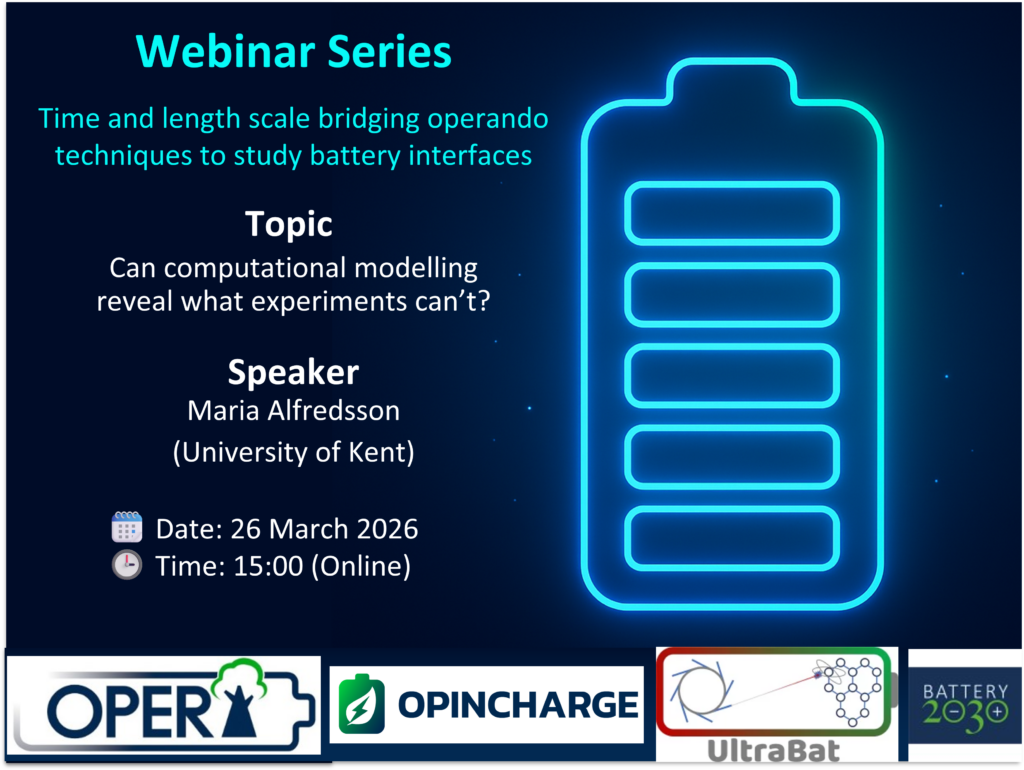
Speaker Maria Alfredsson, University of Kent
Topic Can computational modelling reveal what experiments can’t?
Abstract
A combination of complementary experimental techniques allows us to build a detailed picture of chemical structures and processes in the bulk, at surfaces, and across interfaces of energy materials. Yet experimental interpretations are ambiguous, and multiple explanations can appear equally plausible. This raises a central question: can computational modelling guide and refine the interpretation of experimental data?
This presentation explores how modelling can support studies of energy materials, but primarily for Li‑ion battery applications. The presentation explores calculations on key structural, electronic, and transport properties that complement or predict experimental observations. We will consider questions such as:
· Can oxygen diffusion mechanisms in SOFC materials be clarified by combining EXAFS with molecular dynamics simulations?
· Can DFT accurately predict XAS spectra for systems such as LiFeSO₄F, Li₂FeSiO₄, and NMC?
· Can DFT help explain why the CEI leads to self‑charge in polyanion cathodes?
· Can atomistic simulations predict the cycling behaviour of anode materials?
· Can DFT shed light on NMC degradation pathways and motivate new experimental measurements?
Join the meeting via Zoom:
https://us06web.zoom.us/launch/edl?muid=6ea38588-969d-45b2-920a-aed3ddd6d0f6
Meeting-ID: 885 1850 0854
Password: 124314