The fifth BID, Battery Innovation Days, gathering European battery research, innovation, policy and industry, took place in Graz, Austria in the beginning of December. We got together to discuss how cell development can speed up, battery packs be cheaper, and how new kinds of batteries, like sodium batteries, can reach the market and contribute to Europe’s competitiveness.
EV cars is the main driver for the expected growth of batteries. A coming driver will be drones, unmanned vehicles, special maritime ditto and airplanes. But outdated production models limit EU, we need more of highly flexible production, customized high-performance cells, and complete control of the value chain, meant several speakers. And it should also be affordable and green.
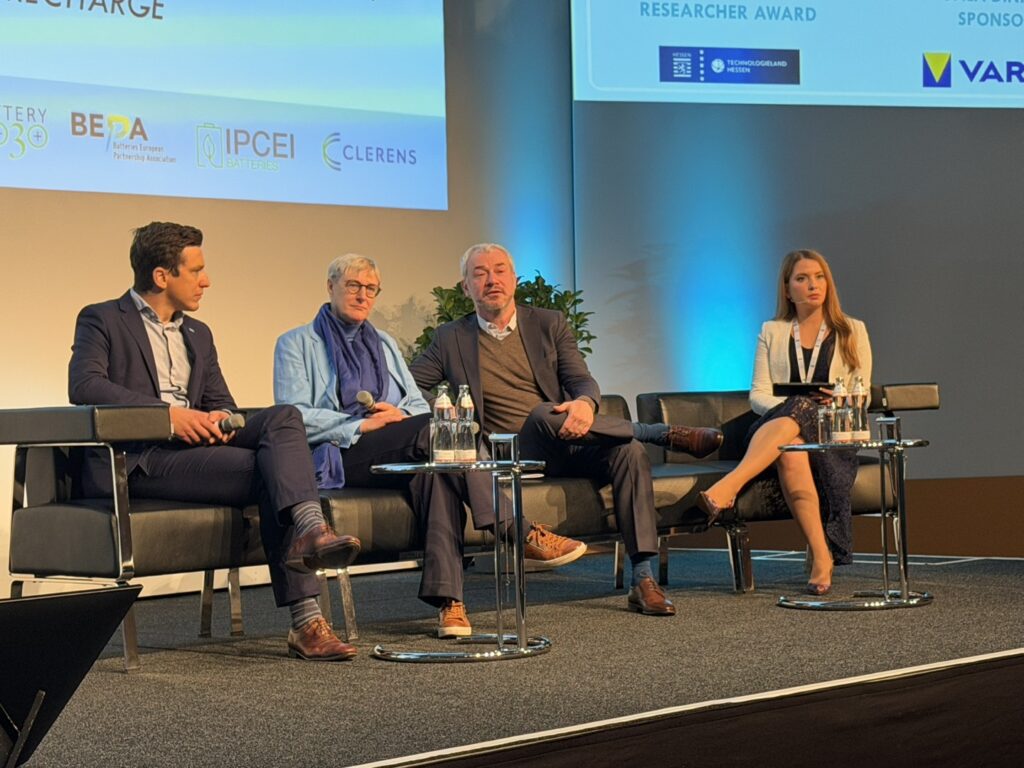
Ideas of how all this can be carried out is outlined in “A battery deal for Europe” written by BEPA and Recharge. Europe must reinforce its R&I framework, innovation should cover the entire value chain, and Europe must enhance its ability for industrial scale-up. To buy European and safeguard European industry against unfair competition and excessive dependency is also part of the deal.
So what are we working on
Wouter Ijzermans, BEPA, moderated a discussion on how AI driven digital twins can analyse terabites of data, and how workers can go from repetitive machine tenders to quality supervisors, ensuring low defects. BMW showed a film where robots work side by side with humans and talked about the special considerations that this requires. The research speed and robustness for new battery materials can be significantly enhanced by AI, in combination with a clever data infra structure and ontology, said Mesfin Haile Mamme, VUB, the leader of Full-Map, a B 2030+ project. Traditionally materials are discovered by accident or trial and error; the first not particularly reliable, the latter time consuming, he continued. The experiments Full-Map does are automatically validated at lab scale, and the ambition is also that the AI shall suggest the next test. The aim is to speed up the quest for new materials and combinations thereof with a factor of 4-5.
Alejandro A. Franco at University of Picardie Jules Verne, has for many years been bridging battery material processing and manufacturing. His work seamlessly integrates physics-based modeling with AI and Machine Learning. To tackle high scrap rates in industrial production, his group has created more than 100 models to predict the influence of each manufacturing process step on the electrode and cell qualities. Applications include simulating complex processes like slurry drying in just seconds (which otherwise takes hours) and predicting cell-level wettability heterogeneities. The developed software allows doing inverse design, where you can feed in the desired properties for your battery and get back the possible manufacturing recipe. His research is the foundation of his spin-off, Aikemics, which transfers these models to the industry sector.
Sulphur is cheap and abundant, environmentally friendly and can also be produced with very high density. It sounds promising, nevertheless there are several problems to solve, and according to Louis De Taeye, Imec disruptive innovation is required before we have Li-S batteries on the market. Sulphur dissolves, which means loss of capacity. Li-metal has a tendency to form dendrites, which results in the loss active lithium and short-circuit, and finally the conductivity is rather low and thus limits the overall performance.
Young scientists go forward
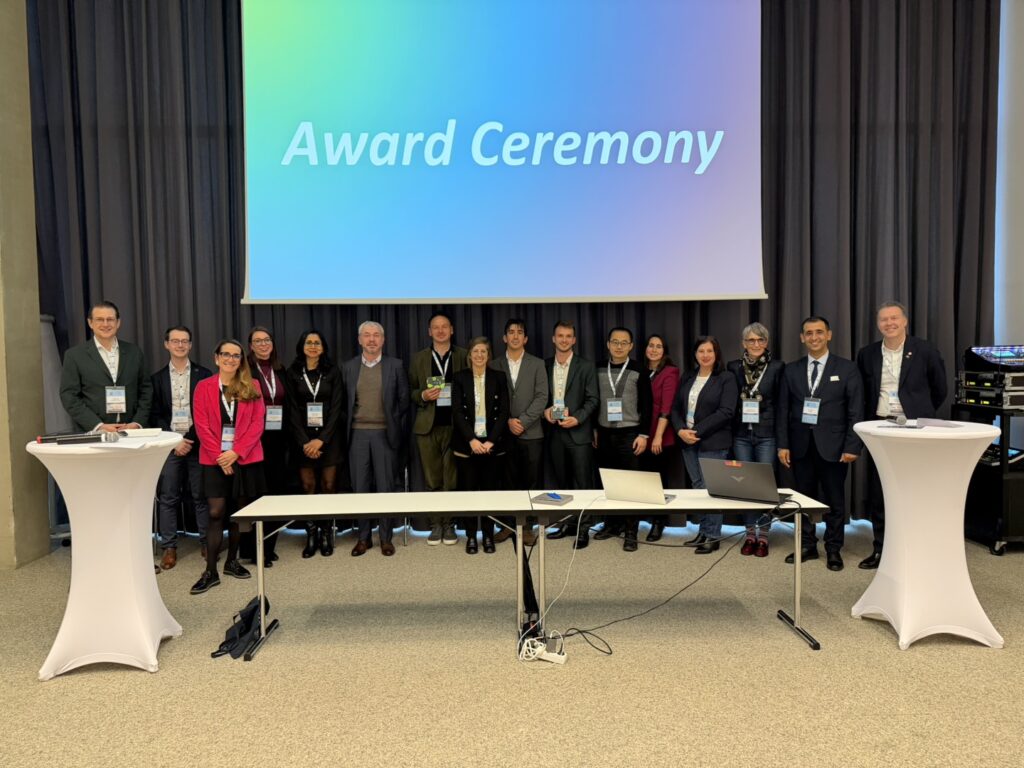
This year’s Young Scientist Award went to Till Ortman at Justus-Liebig University Giessen, for his work with sodium metal electrode and its interfaces with solid electrolytes. He gave a short talk about the microstructure of sodium. The diploma was handed out by Silvia Bodoardo, professor at Polito and part of the B 2030+ consortium, and a strong voice for education of European curricula in the battery field.
BID Innovation Uptake Session was organized by B 2030+ together with VDI/VDE and Fraunhofer. The battery market today is a 3 trillion USD-market, so even a small share is a sustainable amount of money, said Patrik Johansson, the director of B 2030+ – so how do you to take your idea to the next level? Nine innovations ideas were pitched ranging from new kind of polymers to platforms for handling big sets of experimental data efficient, or ensure environmental compliance and traceability in the recycling process. Other ideas were electrified leaching process, also for recycling, or nuclear batteries. The winning pitch among the jury was given by Johannes Durschang at Elevated Material dealing with ultra-thin lithium sheets and the popular vote was won by Carsten Büchner at Fraunhofer for his pitch about ultrasonic diagnostics.
Next year we meet in Stockholm, on November 11-12. See you there!